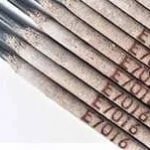
If you bought a budget MIG welder from Amazon, Harbor Freight, or a big-box store, chances are it came with a spool of wire labeled E71T-GS.
This is the “Gateway wire” of welding. It requires no gas cylinder, works outdoors in the wind, and burns through galvanized steel like it isn’t even there. But it is also one of the most misused wires in the industry.
Many fabricators mistakenly think “Gasless Wire is Gasless Wire.” Wrong. Using E71T-GS on a heavy structural multi-pass weld is a recipe for disaster.
In this in-depth guide, we decode the “GS” classification, explain the critical Polarity Rule, and reveal why you should never, ever weld over this wire twice.
E71T-GS is a flux-cored self-shielded MIG welding wire used for single-pass welding applications. The main applications of E71T-GS are high-speed and high-weld deposition fillet welds in all welding positions.
What does E71T-GS mean?
To understand the limitations of this wire, we have to break down the AWS classification. Unlike solid MIG wire (ER70S-6), flux-cored classifications tell you exactly how the wire behaves.
- E: Electrode.
- 7: Tensile Strength of 70,000 psi (Minimum).
- 1: All Positions. You can weld Flat, Horizontal, Vertical, and Overhead.
- T: Tubular. It is a hollow metal tube filled with flux powder.
- G: General Classification. This means the chemistry isn’t strictly defined by a specific AWS standard but agreed upon by the manufacturer.
- S: Single Pass Only. (This is the most important letter on the spool).
The “S” Warning: The “S” stands for Single Pass. This wire is chemically designed to be used for one weld pass only.
E71T-GS Welding Wire Chemical Composition
E71T-GS Welding Wire Chemical Compositions are shown in the below table. Values stated as single is the maximum permitted.
| Element | C% | Mn% | Si% | S% | P% | Cr% | Ni% | Mo% | V% | Al% | Cu% |
|---|---|---|---|---|---|---|---|---|---|---|---|
| % Composition | 0.30 | 1.75 | 0.90 | 0.03 | 0.03 | 0.20 | 0.50 | 0.30 | 0.08 | 1.8 | 0.35 |
E71T-GS Welding Wire Mechanical Properties
E71T-GS Welding Wire Mechanical Properties are given in the table below. E71T-GS has a tensile strength of 70 Ksi minimum.
The yield strength, %age elongation and toughness requirements for the E71T-GS welding wire are not specified in AWS A5.20. Hence, it must be specified by the purchaser in case toughness requirements are applicable.
| Properties | Values |
|---|---|
| Tensile Strength, Ksi (MPa) | 70 minimum (490) |
| Minimum Yield Strength, Ksi (MPa) | Not specified |
| Elongation, minimum | Not specified |
| Toughness | Not specified |
Refer to AWS A5.20 Figure 1 for detailed commentary on various flux-cored arc welding electrodes’ full meaning.
E71T-GS Welding Wire Specification
E71T-GS Welding Wire Specification is AWS A 5.20. In AWS 5.20 specs all properties and characteristics of E71T-GS MIG welding wire are specified.

The “Single Pass” Limitation: Why?
Why can you only make one pass?
To function without shielding gas, the flux inside E71T-GS is packed with powerful scavengers and deoxidizers (typically Aluminum, Magnesium, and Titanium). These elements react with the nitrogen and oxygen in the air to protect the molten puddle.
- On a Single Pass: These elements do their job and float to the surface as slag or remain in the weld at safe levels.
- On Multiple Passes: If you weld over the first bead, you are melting the base metal plus the highly alloyed first weld. The scavengers (Aluminum/Magnesium) accumulate in the weld metal.
The Result: The weld becomes incredibly hard and brittle. If you try to weld a 1-inch plate with 10 passes of E71T-GS, it will likely crack down the center as it cools.
The Polarity Rule: DCEN (Straight Polarity)
This is the #1 mistake new welders make.
- Solid Wire (MIG): Uses DCEP (Electrode Positive). The heat is in the metal.
- Gasless Wire (Flux Core): Uses DCEN (Electrode Negative). The heat is in the wire.
If you run E71T-GS on DCEP (standard MIG settings), the wire will burn back to the tip, spatter uncontrollably, and barely penetrate the steel. You must switch your ground clamp to Positive (+) and your torch to Negative (-).
Comparison: E71T-GS vs. E71T-11
These are the two most common gasless wires. They look the same, but they are not interchangeable.
| Feature | E71T-GS | E71T-11 |
| Passes | Single Pass Only | Multi-Pass Capable |
| Arc Characteristics | Smooth, spray-like transfer | Slightly rougher, globular |
| Galvanized Steel | Excellent (Best choice) | Good |
| Thickness Limit | Max 3/16″ (5mm) recommended | Can weld thicker sections (limited by machine) |
| Impact Toughness | Poor (Not rated) | Poor (Not rated) |
| Seismic/Structural? | NO | NO |
E71T-GS Tensile Strength
E71T-GS tensile strength is 70 Ksi or 490 MPa minimum. The yield strength, minimum % elongation and Charpy V-Notch impact toughness for E71T-GS are not specified in AWS A5.20 specification.
What kind of wire is E71T-GS?
E71T-GS is a flux-cored tubular wire for FCAW or MIG Welding applications. The wire is specially formulated that does not require any external welding shielding gas and hence is classified as a Self-shielded welding wire.
What does GS Mean in E71T-GS?
The meaning of GS in E71T-GS welding wire is:
- ‘’G’’ means that the polarity and usability characteristics of this wire are not specified in the AWS A5.20 specification. The manufacturer can decide on the polarity and characteristics of this wire like ER70S-G welding wire.
- ‘’S’’ means that the welding wire is to be used for single-pass welding only.
E71T-GS Welding Wire Polarity
The welding polarity for E71T-GS is not specified in the AWS A5.20 specification. Usually, E71T-GS can be used with DCEP and DCEN welding polarity.
Welding with DCEN (Straight polarity) is beneficial when welding thin metals and prevent burn thorough problem during welding.
E71T-GS Settings
E71T-GS Settings depend upon the material thickness and electrode wire diameters. When welding thin materials, welding with straight polarity is recommended.
When welding with 0.035-inch E71T-GS wire diameter, use 130- 150 amperage and 22-28 volts. Higher welding current is required when using 0.045-inch dia. wire, around 150- 350 amperage.
Applications: Where does GS shine?
Despite its limitations, E71T-GS is a legendary problem solver in specific scenarios:
1. Galvanized Steel Fencing
Zinc coating (galvanizing) is the enemy of welding. It explodes, pops, and causes porosity. E71T-GS has such aggressive scavengers that it can “eat” through the zinc plating better than almost any other wire, leaving a solid weld underneath.
2. Windy Outdoor Repairs
If you are fixing a tractor gate in a pasture, shielding gas will blow away. E71T-GS creates its own wind-proof shield.
3. Thin Sheet Metal (Auto Body)
Because it runs on DCEN (Straight Polarity), roughly 70% of the heat is kept in the wire, not the base metal. This makes it less likely to burn through thin sheet metal compared to solid MIG wire, provided you move fast.
E71T-GS Multi pass or single pass?
Does E71T-GS is a Gasless wire?

Material Welding is run by highly experienced welding engineers, welding trainers & ASNT NDT Level III bloggers.
We strive to provide most accurate and practical knowledge in welding, metallurgy, NDT and Engineering domains.