What is Nick Break Test
In the pipeline welding (API 1104) and welder qualification, radiography can tell you a lot, but it can’t tell you everything. Sometimes, you just have to break the metal open and look inside.
The Nick Break Test is a destructive testing method used to assess the internal soundness of a weld. Unlike a Tensile Test (which measures strength) or a Bend Test (which measures ductility), the Nick Break is a brute-force interrogation of the welder’s ability to deposit clean, defect-free metal.
If you are a welder preparing for your API 1104 qualification or an inspector evaluating coupons, this is your definitive guide.
A nick break test, also known as a fracture test, is a welding quality assurance test used to determine the soundness of a weld. The test involves taking a small sample of the weld and breaking it apart to check for any cracks or other defects.
Nick Break Test is applied to a welded butt joint in a plate or pipe to check weld soundness. The typical specimen dimensions for plate and pipe. It is not necessary to remove the weld reinforcement.
What is a Nick Break Test?
The Nick Break test involves taking a weld coupon, cutting small notches (“nicks”) into the sides of the weld to create stress concentrators, and then physically fracturing the specimen.
The nicks force the break to occur directly through the center of the weld metal. This exposes the internal cross-section, allowing the inspector to visually examine the “guts” of the weld for trapped defects that might otherwise be hidden.
How do you perform a nick break test?
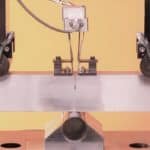
The sample is braced as shown in the Below figure and ruptured by giving one or more sudden heavy blows with a hammer at the point of the nick or the notch as indicated.

Force to break the specimen in Nick break test can be applied by:
- Pulling
- Striking with a hammer
- Bending
The rate of applying the force is not critical, because it has no effect on the appearance of the fractured surface.
The Procedure (API 1104 Standard)
While ASME Section IX utilizes this test (mostly for fillet welds), API 1104 is the code where the Nick Break reigns supreme. Here is the standard procedure:
1. Specimen Preparation
- Cutting: The specimen is cut transversely from the pipe or plate (usually about 230mm / 9″ long and 25mm / 1″ wide).
- Notching: You must cut notches into the sides of the weld metal using a hacksaw or bandsaw.
- Depth: Notches should be approximately 3mm (1/8″) deep.
- Location: They are placed on the weld edges, not the face or root. This ensures the fracture path travels through the deposited weld metal, not the Heat Affected Zone (HAZ).
2. The Break
The specimen is placed in a jig, tensile machine, or simply clamped in a vice. Force is applied—either by pulling (tensile), pushing (bend press), or striking with a hammer—until the piece snaps.
Pro Tip: If using a hammer, clamp the specimen securely just below the notch line. A sharp, committed strike is better than multiple small taps, which can deform the metal before breaking it.
Nick Break Test Defects
The surface of the fracture is examined for the presence of internal defects, such as lack of fusion, slag inclusions, and porosity. Fisheyes during examination of nick break test is not a reason for rejection as allowed in API 1104.
This test can be conveniently carried out in shops and at Sites for quick assessment of weld quality, since no elaborate equipment is necessary, and the interpretation is relatively simple.
Nick Break Test Specimen
Nick break test specimen are similar to bend test specimens. The only difference is the presence of artificial notch prepared by grinding on the nick break test specimen.
As per API 1104, nick break test specimen dimensions are:
- Length: Approximate 9 inch (230 mm)
- Width: 1 inch (25 mm)
- Depth of notch: 1/8 inch (3 mm)
The specimen can be cut by machining or gas cutting.
Nick break test specimen can have notch in three possible ways as:
- Side Notch (most commonly used)
- Face Notch
- Root notch

Similar to bend test, Nick break test or Fracture test can be carried out to break the specimen from side, face or root side to reveal the internal welding defects.
Fracture Test (Nick Break test) in Workshop
You can perform the fracture test in welding shop with minimal efforts. The test is performed by holding the specimen in a vice and then blowing with a hammer on the transverse side to make it fracture.

Defect Interpretation: What are we looking for?
Once the specimen is broken, the inspector examines the two fractured faces. They are looking for three specific “Code Killers”:
1. Gas Pockets (Porosity)
These appear as smooth, round, or cylindrical hollows in the shiny grey fracture surface. They are essentially trapped gas bubbles.
- The Look: Like a bubble in a chocolate bar.
- The Cause: Drafts (loss of shielding gas), moisture in the rod, or long-arcing.
2. Slag Inclusions
These are non-metallic solids trapped in the weld.
- The Look: Dark, glassy, or jagged chunks usually found near the “wagon tracks” (the toes of the root pass or hot pass).
- The Cause: Poor inter-pass cleaning or incorrect rod angle preventing slag from floating to the surface.
3. Incomplete Fusion (Cold Lap)
- The Look: A flat, smooth area that looks like the original bevel face. It means the weld metal laid on top of the parent metal but didn’t bond to it.
- The Result: Instant Failure.
Acceptance Criteria (API 1104)
This is the numbers game. Under API 1104 (Section 5.6.3.3), a weld passes the Nick Break test only if:
- Complete Penetration/Fusion: The exposed surface shows complete penetration and fusion. (Any area of incomplete fusion is an automatic fail).
- Gas Pockets (Porosity):
- Maximum Size: The greatest dimension of any single gas pocket cannot exceed 1.6mm (1/16″).
- Combined Area: The combined area of all gas pockets cannot exceed 2% of the exposed surface area.
- Slag Inclusions:
- Maximum Width: No single slag inclusion can be wider than 3.17mm (1/8″).
- Maximum Length: No single slag inclusion can be longer than 12.7mm (1/2″).
- Spacing: There must be at least 12.7mm (1/2″) of sound metal between adjacent slag inclusions.
Note on “Fish Eyes”: In cellulosic welding (6010), you may see small bright spots surrounding a pore, known as “fish eyes.” These are caused by hydrogen. API 1104 generally ignores fish eyes unless the pore inside them exceeds the size limits above.
Nick Break Test Code
Nick break test is defined in API 1104 standard. In API 1104, Clause 5.6.3, Nick break test is defined. This clause covers sample preparation, Nick break test method, and test requirements.
ick Break vs. Fillet Break
Don’t confuse the two.
- Nick Break: Used for Groove (Butt) Welds. We notch the sides to force a break.
- Fillet Weld Break: Used for T-Joints. We don’t notch it; we just smash the T-joint flat to see if the root fused to the corner.

Dr. Sandeep Kumar
Hi, I'm Dr. Sandeep Kumar. I am a passionate Welding & Material Expert with a Ph.D. and M.Sc. in Welding Engineering. As an International Welding Engineer (IWE), I bridge the gap between academic research and practical industrial application. My goal is to share high-level knowledge on metallurgy, welding technical knowledge, and engineering best practices to help professionals and students succeed in the field.