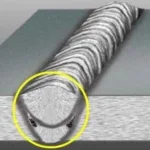
301 stainless steel welds easily with standard 308L filler. The catch is that welding undoes the cold work that gives 301 its strength. Understand that one fact, control heat input and keep everything clean, and you will get sound, corrosion-resistant welds every time.
Quick answer
In this guide
What is 301 stainless steel?
301 (UNS S30100) is an austenitic chromium-nickel stainless steel with about 17% chromium and 7% nickel. It has less nickel than 304, which makes its austenite metastable: when 301 is cold worked, part of it transforms to martensite. That is why 301 work-hardens faster than any other common 300-series grade, and why it is sold in tempers from annealed to full hard.
- Strength comes from cold rolling, not heat treatment. 301 cannot be hardened by heating and quenching.
- It is non-magnetic when annealed but becomes magnetic when cold worked, because of the strain-induced martensite.
Typical uses include rail car and bus bodies, trailer and container panels, aircraft structural parts, springs and clips, automotive trim, conveyor components and cookware.
Chemical composition
Limits per ASTM A240 / A666 (wt %, maximum unless a range is given):
| Element | 301 (S30100) |
|---|---|
| Carbon (C) | 0.15 |
| Manganese (Mn) | 2.00 |
| Silicon (Si) | 1.00 |
| Phosphorus (P) | 0.045 |
| Sulfur (S) | 0.030 |
| Chromium (Cr) | 16.0 – 18.0 |
| Nickel (Ni) | 6.0 – 8.0 |
| Nitrogen (N) | 0.10 |
Note the carbon limit: up to 0.15%, against 0.08% for 304 and 0.03% for 304L. That higher carbon helps strength but makes 301 more prone to carbide precipitation (sensitization) during welding.
Mechanical properties by temper
Most confusion about 301 comes from mixing up tempers. Strength depends almost entirely on how much the sheet was cold rolled. Pick a temper to see its minimum strength, and what the weld zone drops to after welding:
Welding brings this temper’s weld zone down to about annealed strength.
| Temper | Tensile strength, min | 0.2% yield strength, min | Elongation in 50 mm, min |
|---|---|---|---|
| Annealed | 515 MPa (75 ksi) | 205 MPa (30 ksi) | 40% |
| 1/4 hard | 862 MPa (125 ksi) | 517 MPa (75 ksi) | 25% |
| 1/2 hard | 1,034 MPa (150 ksi) | 758 MPa (110 ksi) | 18% |
| 3/4 hard | 1,207 MPa (175 ksi) | 931 MPa (135 ksi) | 12% |
| Full hard | 1,276 MPa (185 ksi) | 965 MPa (140 ksi) | 9% |
Minimums per ASTM A240 (annealed) and ASTM A666 (cold-worked tempers). Elongation minimums for 1/2 hard and harder are slightly lower for gauges below 0.38 mm (0.015 in). Typical annealed sheet tests well above the minimums, often around 750–830 MPa tensile with about 60% elongation.
Physical properties
| Property | Value |
|---|---|
| Density | 7.88 g/cm³ (0.285 lb/in³) |
| Melting range | 1,399 – 1,421 °C (2,550 – 2,590 °F) |
| Modulus of elasticity | 193 GPa (28 × 106 psi) |
| Magnetic permeability | About 1.02 annealed; rises with cold work |
What happens to 301 when you weld it
301 has good weldability by all the common arc processes — GTAW (TIG), GMAW (MIG) and SMAW (stick) — plus resistance spot and seam welding, which is widely used on rail cars and trailers. Four effects need managing.
1. The weld zone loses its cold-work strength
This is the most important point for anyone welding tempered 301. The heat of welding anneals the weld metal and the heat-affected zone (HAZ). A 1/2 hard sheet with 1,034 MPa minimum tensile strength will have a weld and HAZ closer to annealed strength, around 515 MPa minimum.
- Design the joint for annealed strength at the weld, or place welds in low-stress areas.
- Keep heat input low to keep the softened zone narrow.
- For high-strength assemblies, resistance spot welding is often used because it keeps the softened area small.
2. Sensitization (carbide precipitation)
With up to 0.15% carbon, 301 can form chromium carbides at grain boundaries when it spends time between about 427 and 871 °C (800–1600 °F). The chromium-depleted zones next to those carbides are prone to intergranular corrosion. Thin sheet welded quickly is rarely affected; thick sections, slow multi-pass welds and high heat input are the risk. Use low heat input, stringer beads and a low-carbon (L-grade) filler, and use 301L base metal if the part will see aggressive corrosion.
3. Hot cracking
Fully austenitic weld metal is sensitive to solidification cracking. Standard 308L filler is designed to solidify with a small amount of delta ferrite, typically about 3–10 FN, which prevents it. Avoid fillers or dilution that push the weld fully austenitic, keep the bead width at least equal to its depth, and fill craters at the stop.
4. Distortion
Austenitic stainless steel expands about 50% more than carbon steel and conducts heat about a third as well, so thin 301 sheet distorts easily. Use more tacks at closer spacing, copper backing bars or chill bars, balanced welding sequences, and the lowest current that gives full fusion.
Choosing filler metal for 301
There is no “301” filler metal. The standard choice is the 308 family, whose deposit is slightly richer in chromium and nickel than 301 and contains ferrite for crack resistance. Choose the low-carbon L grade to limit sensitization.
| Joint | GTAW / GMAW wire (AWS A5.9) | SMAW electrode (AWS A5.4) | Notes |
|---|---|---|---|
| 301 to 301 | ER308L | E308L-16 | Standard choice. ER308LSi wets better in MIG |
| 301 to 304 / 304L | ER308L | E308L-16 | Same filler as for 304 |
| 301 to 316 / 316L | ER316L or ER308L | E316L-16 | 316L if the joint needs the 316 side’s pitting resistance |
| 301 to carbon steel | ER309L | E309L-16 | Over-alloyed to absorb dilution from the carbon steel |
| 301 to low-alloy steel, high-temperature service | ERNiCr-3 | ENiCrFe-3 | Nickel-base filler for service above about 370 °C |
Autogenous welding (no filler) works on thin 301 sheet up to about 2 mm, as in TIG edge and lap joints, but the weld then has the base metal’s composition with little ferrite. Add filler where crack resistance or corrosion resistance matters.
Shielding gas by process
A common mistake is to use the same argon–CO2 mix as for carbon steel. For stainless, the right gas depends on the process, and CO2 content should stay low to avoid carbon pick-up in the weld.
| Process | Recommended gas | Notes |
|---|---|---|
| GTAW (TIG) | 100% argon | Argon–helium (e.g. 75/25) for thicker sections and faster travel. Never CO2 or O2 |
| GMAW spray / pulsed | Argon + 1–2% O2, or argon + 2% CO2 | Stable arc with minimal carbon pick-up |
| GMAW short circuit | Tri-mix: 90% He / 7.5% Ar / 2.5% CO2 | Good wetting on thin sheet |
| FCAW | 75% Ar / 25% CO2 or 100% CO2 | Only as the flux-cored wire maker specifies |
| Back purge (root side) | 100% argon (or nitrogen where allowed) | Prevents “sugaring” (heavy oxidation) of the root |
For TIG, a gas lens and a post-flow of a few seconds keep the bead bright. Silver to light straw heat tint is normal. Blue, purple or grey means the shielding or cleaning was inadequate, and that oxide layer must be removed (see post-weld cleaning below).
Welding procedure: step by step
Tap each step to tick it off as you go.
- Clean the joint. Remove oil, marker ink, shop dust and paint with acetone or a stainless-safe solvent. Use stainless-steel wire brushes and grinding discs that have never touched carbon steel; iron contamination rusts later.
- Fit up tightly. Keep gaps small and consistent. Tack every 25–50 mm on thin sheet, more often than on carbon steel, to control distortion.
- No preheat. Austenitic stainless steel does not need preheat. Only dry the joint if it is cold or damp.
- Control interpass temperature. Keep it at or below about 150 °C (300 °F) on multi-pass welds. Let the joint cool instead of welding continuously.
- Keep heat input low. Use stringer beads rather than wide weaves, the lowest current that gives full fusion, and a steady, fairly fast travel speed. Pulsed TIG or MIG helps on thin gauges.
- Shield both sides. Back purge closed joints such as tube and pipe with argon until the oxygen level is low, and keep the purge on until the root has cooled.
- Fill the crater. Use the machine’s crater-fill or taper the current at the stop to avoid crater cracks.
Typical TIG starting points for 301 sheet
Starting values for DCEN with ER308L filler and 100% argon; adjust on a test piece.
| Thickness | Tungsten | Filler rod | Current |
|---|---|---|---|
| 0.8 mm (22 ga) | 1.0–1.6 mm | 1.0–1.6 mm | 20–40 A |
| 1.5 mm (16 ga) | 1.6 mm | 1.6 mm | 50–80 A |
| 3.0 mm (11 ga) | 2.4 mm | 2.4 mm | 90–130 A |
If your work is code-governed, such as pressure equipment or structural, follow the qualified WPS rather than these values.
Post-weld heat treatment
Most welded 301 parts need no post-weld heat treatment. When one is needed, the choice depends on the goal.
| Goal | Treatment | Effect |
|---|---|---|
| Restore full corrosion resistance after sensitization | Solution anneal at 1,010–1,120 °C (1,850–2,050 °F), then cool rapidly: water quench for heavy sections, air cool for thin sheet | Dissolves chromium carbides. Also removes all cold-work strength: the whole part becomes annealed |
| Reduce residual stress or springback with no loss of corrosion resistance | Low-temperature stress relief, below about 425 °C (800 °F) | Partial stress relief. Stays below the sensitizing range |
Never cool slowly from annealing temperature. Slow cooling through 427–871 °C (800–1600 °F) is exactly what causes carbide precipitation and intergranular corrosion. The same applies to “stress relieving” in the 500–850 °C range, which is common for carbon steel but harmful for 301.
Solution annealing a 1/2 hard or full hard part also returns it to annealed strength. If you need the strength of the cold-worked temper, design around the softened weld instead of annealing the whole part.
Post-weld cleaning
Corrosion resistance depends on a clean, continuous chromium oxide film. After welding:
- Remove heat tint (blue, purple, grey oxide) by pickling paste or gel, electrochemical weld cleaning, or fine abrasive with stainless-only tools.
- Passivate with nitric or citric acid to restore the passive layer, especially after grinding or where carbon-steel contamination is possible.
- Rinse thoroughly with clean water to remove all acid residue.
A quick check: a copper sulfate or ferroxyl test shows free iron contamination before the part goes into service.
Common problems and fixes
| Problem | Likely cause | Fix |
|---|---|---|
| Weld or HAZ much weaker than the sheet | Welding annealed the cold-worked temper | Design for annealed strength at the weld; reduce heat input; consider spot welding |
| Rust or rust streaks near the weld | Iron contamination from carbon-steel tools, or heat tint left on | Stainless-only tools; pickle and passivate |
| Intergranular corrosion in service | Sensitization from high heat input or slow cooling | Low heat input, L-grade filler, 301L base metal; solution anneal with rapid cooling if needed |
| Centerline or crater cracks | Fully austenitic weld metal, deep narrow bead, unfilled crater | Use ER308L with ferrite; wider, flatter bead; crater fill |
| “Sugared” (granular, black) root | No back purge | Argon back purge until the root cools |
| Warping and buckling | High heat input, few tacks | More tacks, chill bars, balanced sequence, pulsed current |
| Porosity | Contamination, poor gas coverage, drafts | Clean with solvent; check gas flow and leaks; screen drafts |
Frequently asked questions
Is 301 stainless steel easy to weld?
Yes. It welds as readily as 304 by TIG, MIG, stick and resistance welding. The main thing to plan for is the loss of cold-work strength in the weld zone.
Can I weld 301 with 308L filler?
Yes. ER308L (wire) and E308L-16 (electrode) are the standard fillers for 301.
Can I weld 301 with 316L filler?
It works, and is sometimes used when joining 301 to 316, but it costs more and is not needed for 301 to 301 joints.
Does 301 need preheat?
No. Keep the interpass temperature at or below about 150 °C (300 °F) instead.
Why is my 301 stainless steel magnetic?
Cold work transforms part of the austenite to martensite, which is magnetic. Annealed 301 is essentially non-magnetic; 1/2 hard and full hard are noticeably magnetic. This is normal and does not mean the material is the wrong grade.
Can I get the hardness back after welding?
Not by heat treatment. 301 is strengthened only by cold work, so a welded or annealed area stays at annealed strength.
What is the difference between 301 and 304 for welding?
304 has more nickel and less carbon, so it is more stable and less prone to sensitization. 301 has higher strength in cold-worked tempers but loses more of that strength when welded.
Summary
Weld 301 stainless steel with ER308L or E308L-16 filler, pure argon for TIG and low-CO2 or oxygen mixes for MIG, no preheat, and low heat input with interpass control. Expect the weld zone to be at annealed strength whatever the sheet temper. If a heat treatment is needed, solution anneal at 1,010–1,120 °C and cool rapidly — never slowly. Finish with pickling and passivation for full corrosion resistance.