By Dr. Sandeep Kumar, PhD, IWE, ASNT NDT Level III
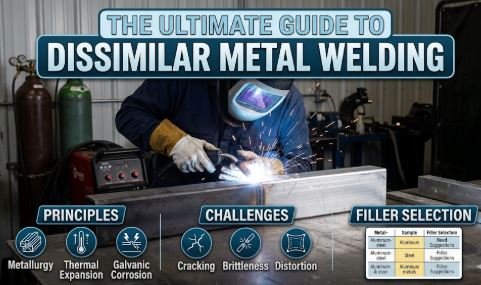
Dissimilar metal welding (DMW) is one of the most complex and critical challenges a welding engineer will face. Whether you are joining carbon steel to stainless steel in a petrochemical refinery, or welding P91 to austenitic stainless steel in a high-pressure power plant, the margin for error is virtually zero.
Improper filler metal selection in a dissimilar joint doesn’t just result in poor aesthetics; it leads to catastrophic failures—often years after the weld has passed its initial NDT inspections. These failures are typically driven by thermal fatigue, carbon migration, or the formation of brittle metallurgical phases.
In this comprehensive guide, we will explore the metallurgical science behind dissimilar metal welding, examine industry best practices based on AWS and ASME guidelines, and provide an interactive calculator to help you select the exact filler metal required for your next project.
The Four Horsemen of Dissimilar Welding Failures
Before selecting a filler metal, a welding engineer must understand why dissimilar joints fail. When joining two different metals, the weld pool becomes a complex, diluted mixture of both base metals and the filler metal. If not carefully managed, four primary mechanisms can destroy the joint’s integrity.
A. Coefficient of Thermal Expansion (CTE) Mismatch
Different metals expand and contract at different rates when heated and cooled. For example, austenitic stainless steel (like 304L) expands approximately 30% more than carbon steel. When these two materials are welded together and subjected to cyclic high temperatures, the weld interface acts as a hinge, absorbing immense thermal stress. Over time, this leads to thermal fatigue cracking, typically along the fusion line of the ferritic (carbon steel) material.
B. Carbon Migration
When joining a low-alloy ferritic steel (e.g., 2.25Cr-1Mo or P91) to an austenitic stainless steel, carbon migration occurs during Post Weld Heat Treatment (PWHT) or high-temperature service. Carbon naturally diffuses from the lower-chromium ferritic steel into the higher-chromium austenitic steel. This creates a soft, weak, decarburized zone on the ferritic side and a hard, brittle, carbide-rich zone on the austenitic side, making the joint highly susceptible to creep-rupture.
C. Dilution and Brittle Phase Formation
During welding, the base metals melt and mix with the filler metal—a process known as dilution. If you weld carbon steel to stainless steel using a standard 308L filler, the carbon steel dilutes the chromium and nickel content of the weld pool. The resulting weld metal will likely fall into the martensitic zone of the Schaeffler diagram, meaning the weld will be extremely hard, brittle, and prone to immediate hydrogen-induced cold cracking (HICC).
D. Galvanic Corrosion
In conductive environments (like seawater), joining two dissimilar metals creates a galvanic cell. The less noble metal (anode) will corrode at an accelerated rate to protect the more noble metal (cathode). Proper filler metal selection must account for the galvanic series to ensure the weld metal does not become anodic to the massive base metals surrounding it.
Advanced Metallurgy Challenge
Question 1 of 8
Predictive Tools: The Schaeffler and WRC-1992 Diagrams
Welding engineers do not guess when it comes to dissimilar metals; they use predictive diagrams.
The Schaeffler Diagram (and the modernized WRC-1992 Diagram) plots the Chromium Equivalent (ferrite formers) against the Nickel Equivalent (austenite formers). By calculating the dilution ratio—typically 30% from the base metals and 70% from the filler in standard arc welding—engineers can predict the exact microstructure of the final weld deposit at room temperature.

The golden rule of dissimilar welding (particularly for Carbon Steel to Stainless Steel) is to target a weld deposit that is primarily Austenitic with a small amount of Delta Ferrite (typically 3% to 8% or 3 to 8 FN). This structure is highly ductile and completely immune to hot cracking.
3. Advanced Dissimilar Welding Calculator
To streamline your WPS development, use our interactive selection tool. This logic is built upon AWS A5.4, AWS A5.9, AWS A5.11, and API RP 582 guidelines for dissimilar combinations.
Advanced Dissimilar Metal Selector
Carbon • Stainless • Duplex • Nickel • Aluminium • Copper Alloys
Key Engineering Guidelines for Specific Combinations
Let’s break down the technical rationale behind the most common—and problematic—dissimilar combinations you will encounter in the field.
A. Carbon Steel to Austenitic Stainless Steel (The 309L Rule)
This is the most common dissimilar joint. If you use a matching carbon steel filler, the weld will lack ductility. If you use a matching 308L stainless filler, the carbon steel will dilute the nickel content, shifting the weld deposit into the martensitic zone.
The Solution: Use AWS E309L or ER309L. Type 309L is specifically designed to be “over-alloyed” (roughly 23% Chromium and 13% Nickel). Even after 30% dilution from the carbon steel base metal, the resulting weld chemistry remains squarely in the safe, ductile austenitic zone.
B. High-Temperature Creep Steels (P91 / Cr-Mo) to Stainless Steel
In power generation plants, you often have to join a ferritic boiler tube (like Grade 91) to an austenitic superheater tube (like 304H). Using a stainless filler here is a fatal mistake. At service temperatures above 400°C, carbon will rapidly migrate out of the P91 and into the stainless weld metal.
The Solution: Use a Nickel-Based Alloy like ERNiCr-3 (Inconel 82) or ENiCrFe-2 (Inconel A). Nickel has a very low affinity for carbon, acting as an impenetrable barrier that stops carbon migration dead in its tracks. Furthermore, the CTE of Inconel sits perfectly halfway between Carbon Steel and Stainless Steel, acting as a thermal shock absorber during plant start-ups and shut-downs.
C. Duplex / Super Duplex to Carbon Steel
Duplex stainless steels rely on a delicate 50/50 balance of Austenite and Ferrite. Joining 2205 Duplex to Carbon Steel dilutes this balance.
The Solution: For standard 2205 Duplex, use E309LMo or ER309LMo. The addition of Molybdenum maintains the pitting corrosion resistance. However, if you are welding Super Duplex (2507) to Carbon Steel, standard 309LMo is insufficient. You must step up to a Nickel alloy like ERNiCrMo-3 (Inconel 625) to prevent the precipitation of intermetallic phases (like Sigma phase) during cooling.
D. Welding Cast Iron to Carbon Steel
Cast iron contains massive amounts of carbon (2% to 4%). Welding it with a standard E7018 carbon steel rod will pull that carbon into the weld pool, instantly creating a weld that is as brittle as glass and impossible to machine.
The Solution: Use AWS ENi-CI (99% Nickel) or ENiFe-CI (Nickel-Iron). Nickel does not form carbides. The resulting weld remains soft, ductile, and easily machinable, yielding to the shrinkage stresses rather than cracking.
Advanced Metallurgy Challenge
Preheat and PWHT Rules for Dissimilar Joints
Selecting the right filler metal is only half the battle. Heat treatment determines the final survival of the joint.
1. The Preheat Rule: When joining two different metals, the preheat temperature is almost always dictated by the more hardenable (higher carbon/alloy) material. For example, if welding P22 (which requires 150°C preheat) to Carbon Steel (which may only require 10°C), you must apply the 150°C preheat to the entire joint to prevent underbead cracking in the P22 Heat Affected Zone (HAZ).
2. The PWHT Rule: Post Weld Heat Treatment in dissimilar joints is treacherous. PWHT is usually governed by the lower-alloy material.
- If you weld P22 to Carbon Steel, standard P22 PWHT is around 700°C. However, heating Carbon Steel to 700°C pushes it dangerously close to its lower critical transformation temperature, potentially ruining its mechanical properties.
- The Buttering Technique: To solve this, engineers use “Buttering.” The P22 pipe is “buttered” (overlayed) with the Inconel filler metal. The P22 is then put in the furnace for PWHT by itself. After it cools, the buttered P22 face is welded to the Carbon Steel pipe using Inconel filler, and no further PWHT is required, saving the Carbon Steel from heat damage.
Conclusion
Dissimilar metal welding requires a deep understanding of metallurgy, thermodynamics, and phase diagrams. By adhering to the principles of over-alloying, utilizing nickel buffers for high-temperature service, and meticulously planning your heat treatment cycles, you can achieve defect-free joints that last decades.
Frequently Asked Questions
Expert answers to common dissimilar welding challenges.
What is the best welding rod for joining carbon steel to stainless steel?
Do I need to preheat when welding dissimilar metals?
Why can’t I use an E7018 rod to weld stainless steel to carbon steel?
What is carbon migration in dissimilar metal welds?
How do you weld Inconel to carbon steel?

Dr. Sandeep Kumar
Dr. Sandeep Kumar is a distinguished NDT Expert holding the prestigious ASNT NDT Level III certification. Backed by a Ph.D. and M.Sc. in Welding Engineering, he provides expert insights into material inspection, quality assurance, and flaw detection. Dr. Kumar is dedicated to advancing NDT practices through education and technical leadership.